
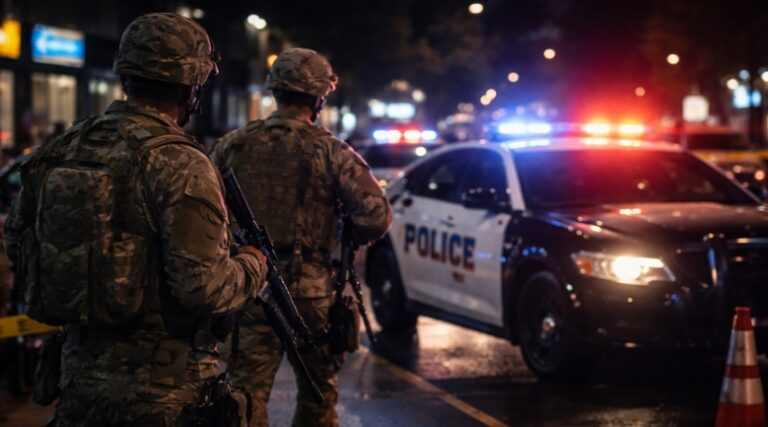
On September 15, 2025, President Donald Trump signed a Presidential Memorandum directing the deployment of the National Guard to Memphis, Tennessee. The deployment, which was part of a coordinated law enforcement surge aimed at addressing rising violence levels, involved personnel from a handful of federal agencies.
For local law enforcement professionals, this deployment raised critical questions about resource allocation, operational coordination, and the relationship between federal and local policing efforts. At National Police Support Fund, our mission is to support and advocate for officers serving on the ground. Understanding how large-scale federal deployments affect local law enforcement capacity, morale, and effectiveness is essential to ensuring that officers can serve their communities safely and effectively.
What We Know About the Deployment
The original Presidential Memorandum was signed on September 15, 2025, and it directed a comprehensive federal task force to Memphis. This force included National Guard troops as well as agents from the FBI, the Drug Enforcement Administration (DEA), Immigration and Customs Enforcement (ICE), and the U.S. Marshals Service. In addition, state police from Mississippi and Arkansas, as well as National Guard members from other states, were ready to provide reinforcements.
The deployment comes amid a complex crime picture in Memphis. The White House, at the time of the announcement, noted that the city’s total crime rate was significantly higher than the national average. However, according to Memphis police, during the first eight months of 2025, murder was at a six-year low.
These conflicting narratives underscore the complexity of the crime situation and raise important questions about how the federal presence will be coordinated with ongoing local efforts.
Resource and Operational Implications for Local Police
A critical concern for local law enforcement is the role they will play in this federalized operation. Will Memphis police officers be integrated into the task force to support federal operations at the ground level? Or will they be sidelined as federal agencies take primary responsibility for crime-fighting efforts in key areas?
Large-scale federal deployments place immediate strain on local departments’ resources. Officers may be redirected to support federal operations, diverted from community policing efforts, or reassigned to provide administrative support. Additionally, when federal agencies operate within a city, they often bring their own protocols, command structures, and resource allocations. Without appropriate coordination, this can create gaps in local police operations, requiring officers to work across multiple chains of command.
The implications for officer safety and well-being are substantial. When federal deployments arrive without straightforward integration with local departments, officers may lack situational awareness about ongoing federal operations in their jurisdiction. Training disparities, different communication protocols, and unclear operational boundaries can all compromise officer safety. Furthermore, the rapid influx of personnel and resources can exacerbate existing tensions between local citizens and law enforcement.
Legal, Policy, and Funding Considerations
The deployment also raises significant constitutional questions that directly affect how local officers operate.
The Posse Comitatus Act historically restricts the use of federal military forces in domestic law enforcement. By deploying National Guard troops in cities, federal authorities are asserting expanded federal authority in a way that warrants scrutiny. State and local leaders must ensure that federal operations remain within legal boundaries and that state sovereignty is respected in policing decisions.
Funding concerns are equally important. Federal deployments, while providing short-term resources, do not address the underlying issues of local police departments. Short-term federal action cannot substitute for sustainable investments in local law enforcement: once the federal agents leave, the city will still have to deal with preexisting critical gaps in training, equipment, staffing, and community policing programs. This leaves officers vulnerable to future crises.
Adequate long-term safety requires a balanced approach: federal resources can address acute situations, but local departments must receive sustained investment to serve their communities independently.
Officer Perspective and Public Trust
The arrival of a large federal task force sends powerful signals to the public. For local police, the message can feel mixed: on one hand, federal reinforcements mean the city’s challenges are being taken seriously at the highest levels. On the other hand, it can also be perceived as a lack of confidence in local leadership.
Memphis Mayor Paul Young expressed reservations about the deployment, questioning whether it was the right approach to reducing crime. This lack of alignment between local leadership and federal action created an uncertain environment for officers, who must work effectively while their own department leadership raises concerns about the strategy.
Public trust in local police can also be affected by federal deployments. Federal operations, especially large-scale law enforcement surges, can alter community dynamics and citizen perceptions of local police. If the federal presence feels heavy-handed, or if federal and local officers use different community engagement strategies, the relationship between residents and local police can be damaged.
Additionally, when officers from multiple agencies work in the same jurisdiction, they must coordinate across different training protocols, communication systems, and organizational cultures. This complexity requires clear leadership, robust communication, and a commitment to ensure that every officer, regardless of which agency they represent, operates with respect for local communities and constitutional principles.
Our Perspective and Recommendations
The National Police Support Fund recognizes that public safety requires partnerships across federal, state, and local levels. However, sustainable, effective policing begins with strong, well-resourced local departments. Federal deployments can address acute situations, but they are not substitutes for long-term investment in officer training, equipment, and community-oriented policing strategies.
We recommend that federal and local leadership prioritize the following:
- Support for Local Officers: Rather than sidelining local police, federal and local agencies should work collaboratively, and local officers should be fully integrated into task force operations.
- Sustainable Funding Models: Congress and state legislatures should ensure that local police departments receive adequate funding for recruitment, training, equipment, and community programs.
- Accountability and Transparency: Federal deployments should be evaluated against clear metrics that measure both public safety outcomes and their impact on local police operations, officer morale, and community trust. Results should be made public.
Final Thoughts
The deployment of the National Guard and federal law enforcement agencies to Memphis represents a significant moment in the evolving relationship between federal and local, and modern policing. It reflects a growing trend toward reliance on federal intervention to address crime challenges in American cities.
For Memphis Police officers, this moment underscores the need for clear leadership, robust support, and recognition of their essential role in public safety. National Police Support Fund remains committed to advocating for adequate resources, training, and respect for the men and women who serve in law enforcement.
It’s time for all stakeholders to question how federal and local law enforcement resources are allocated and deployed. Our officers deserve sustained investment in their departments, clear authority and accountability structures, and the assurance that their role in serving their communities is valued and supported.