
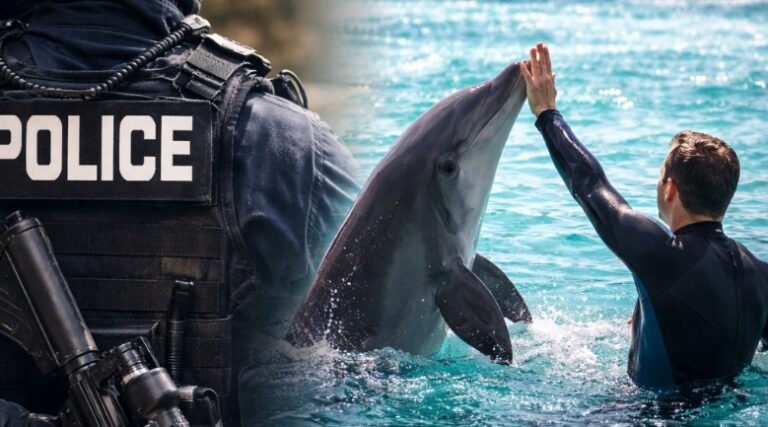
Sgt. Andre Thomas of the San Diego Police Department has an unusual side job. On weekdays, he leads a SWAT team through the demanding work of law enforcement. On weekends, he dons a sleek wetsuit and performs acrobatic routines with dolphins before crowds exceeding 2,700 spectators at SeaWorld San Diego.
At first glance, this story reads like a quirky human-interest piece. But beneath the surface lies something far more significant: a window into officers’ wellness and identity, and how forward-thinking departments can support the whole person, not just the uniform. Thomas’s dual career challenges conventional notions of what a police officer should be, and in doing so, raises critical questions about burnout prevention, departmental flexibility, and the future of officer support.
Thomas’s story demonstrates how departments that recognize officers as multidimensional people, with passions, talents, and pursuits beyond the badge, cultivate healthier, more resilient workforces.
Behind the Headlines: The Dual Role
Thomas’s journey to this unusual crossroads began nearly two decades ago. A Fresno native raised on marine documentaries, Thomas moved to San Diego at eighteen with a clear ambition: to become a marine mammal trainer. In 2008, he took a position as a photographer at SeaWorld’s entrance. This strategic foothold positioned him to pursue his dream.
The following year, he auditioned for a seasonal dolphin internship. Despite facing more than 500 applicants competing for just 16 positions, Thomas succeeded thanks to what colleagues describe as natural charisma and an instinctive ability to read animals. Six months later, his internship became a full-time role.
But in 2013, his family was directly impacted by crime, which catalyzed a transformation in Thomas’s thinking. The next year, he applied to the San Diego Police Department.
Since then, Thomas has worked patrol, served on SWAT, trained recruits at the academy, and earned promotion to sergeant. When possible, he displayed his deep care for animals, even adopting a dog he rescued while on duty. Yet SeaWorld remained a part of him. Thanks to the flexibility of his former supervisor, Wendy Ramirez, Thomas was able to return to work with dolphins approximately once weekly, year-round.
Spending weekdays in uniform and weekends in a wetsuit is a taxing juggling act. However, it illustrates a shift in modern policing. The officer’s role is no longer confined to tactical execution, nor does it take over the officer’s entire life. Today’s law enforcement professionals are leaders, instructors, media liaisons, and community ambassadors.
Officer Wellness, Mental Health & Risk of Burnout
The research is detailed: policing is a high-stress occupation. An officer’s workplace demands include traumatic events, shift work, and ongoing pressure. These factors accumulate, contributing to elevated rates of post-traumatic stress disorder, depression, and suicide ideation among law enforcement personnel. Burnout, which erodes their engagement and sense of purpose, threatens both officers’ well-being and departmental effectiveness.
This is where Thomas’s story becomes instructive. Police leaders increasingly recognize that off-duty pursuits can serve as powerful buffers against occupational stress. A passion pursued outside the uniform provides psychological distance from traumatic exposure, restores a sense of identity beyond the job, and offers intrinsic reward and engagement.
However, the relationship between dual careers and officer wellness is not universally positive. A reasonable question arises: Does an intense weekend commitment affect Thomas’s recovery time? Could fatigue from two demanding roles compromise his performance on SWAT? Does the department lose focus when officers are spread across multiple priorities?
These are legitimate operational concerns. Yet evidence suggests that when officers pursue meaningful activities, the net effect is to build resilience. Colleagues note that Thomas brings enthusiasm and focus to both roles. His well-being is bolstered by regular work that feeds his spirit.
Departmental Support & Policy Implications
The issue of “side jobs” has long raised practical questions for department leaders. How should police organizations structure policies and scheduling to accommodate dual-career officers? What standards ensure that secondary pursuits don’t compromise readiness or safety?
The San Diego Police Department’s approach offers a model. Rather than prohibiting or discouraging such roles, the department has engaged with them. Chief Scott Wahl, initially surprised to discover Thomas performing with dolphins, has become supportive. The department recently assigned Thomas to its media services team, where he can use his multifaceted public-facing talents. This represents intelligent resource allocation: the department recognized that Thomas’s ability to connect with diverse audiences, partly developed through his SeaWorld work, enhances his value in public communications.
Departments must also confront logistical considerations. Scheduling, training continuity, and coverage become more complex when officers maintain secondary roles. However, these are management challenges, not prohibitive barriers. With intentional policy design that includes clear guidelines and transparent expectations about availability, workers can establish healthy boundaries.
Moreover, Thomas’s story serves as a recruitment and morale booster. In an era of officer shortages and burnout, potential recruits see in Thomas’s dual career a department willing to recognize the whole person.
Broader Implications for Modern Policing
Policing is increasingly recognized as a multifaceted profession requiring emotional intelligence, communication skills, community engagement, and diverse ways of thinking. Officers who maintain identities and pursuits outside policing often develop these capacities more fully.
In Thomas’s case, his public visibility as a performer has also subtly improved community relations. Thousands of civilians annually witness a police officer engaged in extraordinary animal care and athletic performance. This humanizes law enforcement agents, showing them as capable, disciplined, and compassionate individuals.
Recommendations for Police Leadership
At the National Police Support Fund, we admire Thomas’s versatility and celebrate the department that has nurtured him. To replicate his success, we believe more departments should:
- Support holistic officer wellness: Recognize that officers thrive when they maintain identities and pursuits beyond policing, and encourage them to pursue these outside of policing.
- Update dual-career policies: Establish clear, flexible guidelines that accommodate secondary pursuits, and enforce them with transparent guidance rather than punitive action.
- Integrate wellness into recruitment and retention: Market departmental support for officer wellbeing and outside interests as recruitment assets.
- Invest in meaningful off-duty opportunities: Departments should actively facilitate officer access to programs, training, and internal positions aligned with their passions.
A Final Thought: Don’t Make Sgt. Thomas an Exception
Sgt. Andre Thomas’s story is not a novelty. It reflects the reality of modern policing: the profession requires and attracts people with depth and capability, whose talents and aspirations extend far beyond enforcement. Police leaders who recognize this will build more resilient, engaged, and effective departments, with better recruitment and lower burnout rates.
Thomas remains committed to both roles because both fulfill him. The San Diego Police Department has discovered that supporting this dual commitment strengthens its SWAT team and enhances its public presence. Other departments should learn from this example and be ready to say, “We will support the whole of you.”