
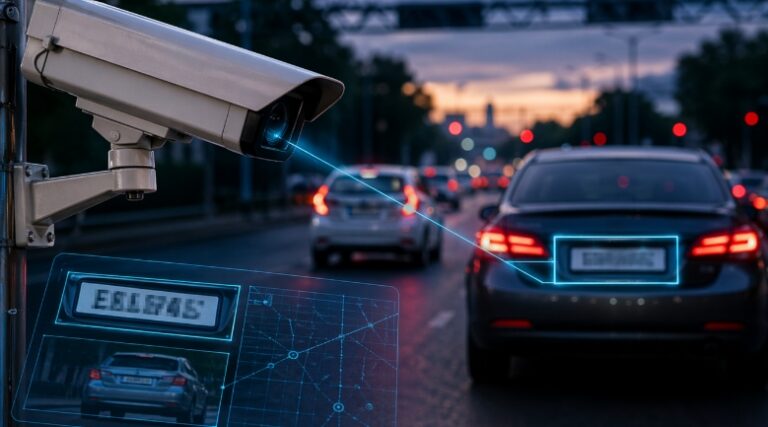
Automated License Plate Reader (ALPR) systems are camera-based technologies that automatically capture and store license plate numbers and other information as vehicles pass by.
Now widely adopted across the country, ALPR technology helps officers prevent crimes and recover stolen property. At the same time, its use raises questions about data retention and its potential misuse.
For law enforcement organizations, the central challenge is clear: how can agencies deploy these new tools while maintaining public trust?
What Are ALPR Systems and How Are They Used
At their core, ALPRs are camera-based devices that capture license plate numbers, vehicle features, along with the scan’s location and time.
This information is typically used to match plates against databases of stolen vehicles, wanted suspects, or missing people. Officers may be alerted immediately upon a match, but stored scan records can also help reconstruct vehicle movements or establish a subject’s presence in a specific area.
These capabilities support a range of real-world law enforcement tasks, such as recovering stolen vehicles, executing felony warrants, or locating missing or endangered people.
Why ALPR Is a Critical Tool for Law Enforcement
ALPRs offer a significant operational advantage over manual plate checks: they process data automatically and continuously, without requiring officers to manually review footage. In this way, they can respond more quickly and accurately, even in time-sensitive situations.
Access to historical ALPR data also enables detectives to place a subject’s vehicle near a crime scene or corroborate witness accounts.
When integrated into data-driven policing strategies, ALPRs can support broader crime-prevention goals and reduce the burden on officers, similar to how targeted enforcement operations focus on repeat offenders to improve public safety outcomes.
Public Trust and Privacy Concerns
The same capabilities that make ALPRs valuable have also raised legitimate concerns. ALPR systems collect data on all passing vehicles, generating large repositories of information about the movements of ordinary citizens.
This data can potentially be misused, invading the privacy of people who have committed no crimes. “False positives,” where a system incorrectly flags a vehicle, can lead to wrongful stops, with serious consequences for innocent individuals.
When the public perceives surveillance as being used unfairly or without accountability, trust in law enforcement erodes. With it, cooperation between officers and the public declines.
Governance, Policy, and Accountability
Strong governance frameworks are essential to ensuring that ALPR technology is used appropriately.
Policy experts recommend legislation that clearly specifies its permitted and prohibited uses. Data retention limits are equally important. These limits will prevent agencies from accumulating vast amounts of location data on individuals indefinitely.
Further trust can be built through transparency portals, where agencies disclose how many ALPRs they operate, how long data is retained, and who has access to it. Finally, local police leaders must set an example and safeguard the balance between operational effectiveness and civil liberties.
Impact on Officers and Daily Policing
For officers, ALPR technology changes the nature of vehicle-related enforcement. Officers working with these systems receive real-time alerts when a flagged vehicle is detected, providing critical context before a stop is initiated. These moments reinforce how routine encounters can quickly turn into high-risk situations.
However, research also highlights that proper training and clear protocols are essential to realizing ALPR technology’s potential. Officer effectiveness also depends on long-term resilience, including how officers maintain identities and pursuits beyond policing.
There is also a risk of over-reliance on technology as a substitute for sound judgment. ALPR should not replace the organizational frameworks and strategies that determine whether law enforcement achieves its public safety goals.
Funding and Resource Considerations
ALPR systems represent a meaningful upfront investment. In addition to the camera units themselves, they require software licenses, training, and IT systems for data storage and system maintenance.
For smaller departments, these costs can be prohibitive. Some agencies have accessed state and federal grant funding to get them started, but sustaining these systems over time reflects the same challenges seen in large-scale federal and local law enforcement coordination efforts.
Broader Implications for Modern Policing
ALPR technology is part of a broader shift toward data-driven policing. As agencies increasingly rely on automated systems, the need for robust data governance frameworks and clear ethical guidelines becomes more pressing.
Research consistently shows that the effectiveness of any technology in policing depends on how it is deployed. Any new plans or proposals must include community engagement around the adoption of surveillance tools. When residents understand how technology will be used, they are better positioned to support law enforcement efforts. That support, in turn, enhances the effectiveness of policing itself.
Our Position
At National Police Support Fund, we believe the thoughtful use of ALPR technology can meaningfully enhance officer safety and investigative effectiveness.
At the same time, we recognize that responsible use requires clear policies and protocols, firm data retention limits, and genuine transparency with local communities. Oversight and accountability are the foundation of public trust, which makes effective policing possible.
Done right, ALPR technology can be a genuine asset to public safety. With the right governance frameworks, training, and leadership, it can advance policing capabilities and help maintain public trust.
Supporting responsible, effective policing requires continued investment in tools, training, and accountability, and you can support that mission by contributing.